
Mathematics & Algebra
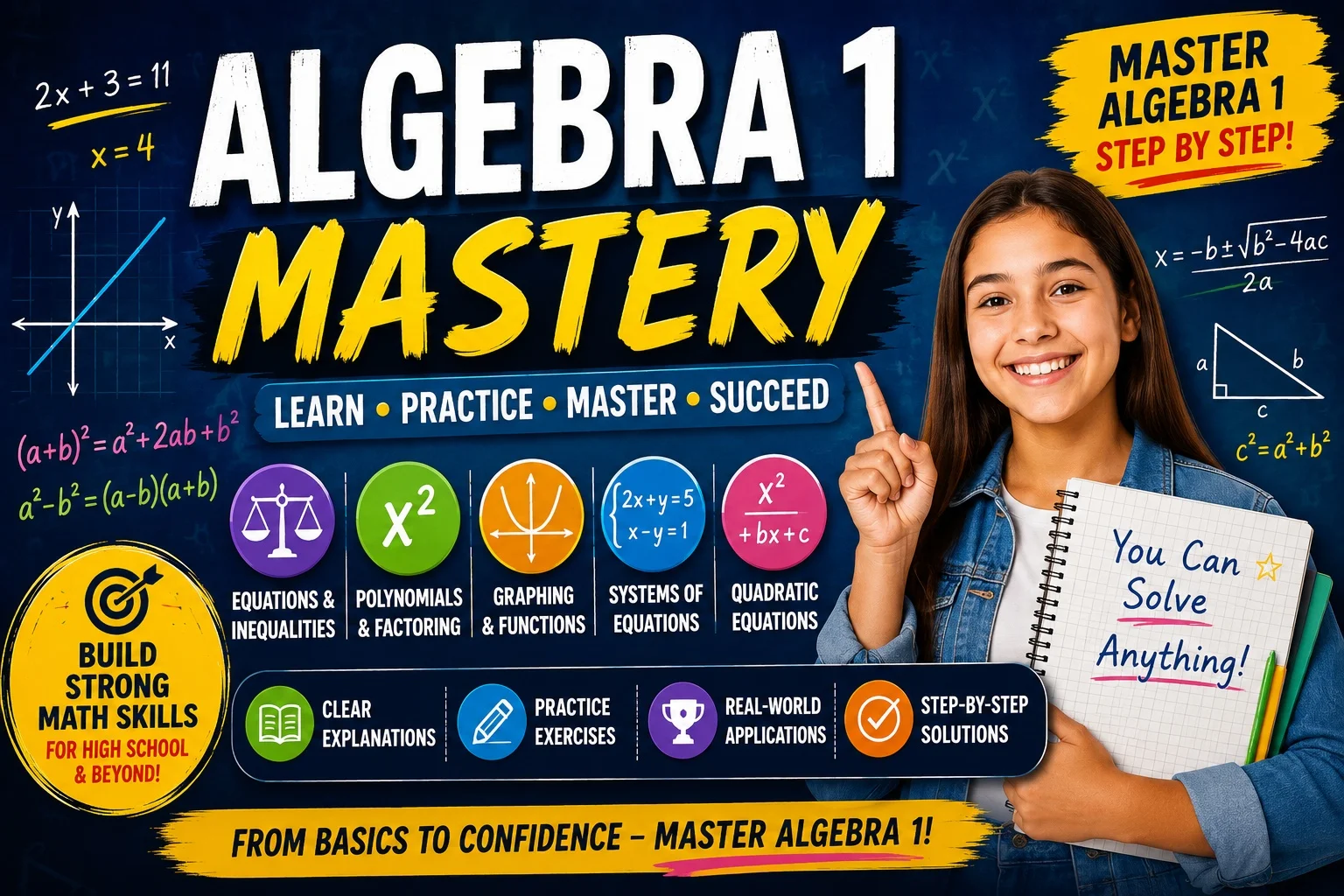
Algebra Mastery for Students: Core Techniques, Formulas, and Real-World Problem Solving
A structured guide for students to master algebraic thinking, equation solving, factoring, graphing quadratic functions, and applying algebra in modern STEM careers.
Algebra is the foundational language of higher mathematics, computer science, engineering, and data analysis. Rather than viewing algebra as a collection of isolated formulas, learners who excel treat algebra as a systematic framework for modeling relationships, patterns, and unknown quantities.
1. Foundations of Algebraic Thinking
At its core, algebra replaces concrete numbers with variables to establish general mathematical rules. Developing algebraic fluency begins with understanding order of operations, properties of real numbers (commutative, associative, and distributive laws), and working confidently with exponents and radicals.
2. Solving Linear Equations and Systems
Linear equations form the backbone of optimization and economics. Students should master:
- Isolating variables using balanced two-sided inverse operations.
- Solving systems of linear equations using substitution, elimination, and matrix methods.
- Interpreting slopes and intercepts geometrically to understand rates of change in physical applications.
3. Polynomials and Factoring Strategies
Factoring polynomials is essential for finding roots and simplifying rational expressions:
- Greatest Common Factor (GCF) extraction.
- Factoring quadratics: trinomial decomposition, difference of two squares, and completing the square.
- The Quadratic Formula: Understanding the discriminant (b² - 4ac) to determine whether roots are real, distinct, or complex.
4. Functions, Graphing, and Quadratic Curves
Visualizing algebraic relationships helps bridge the gap between equations and real-world phenomena. Quadratic curves (parabolas) model projectile motion, antenna focal points, and profit maximization in business economics. Understanding vertex form y = a(x - h)² + k allows learners to find maximum or minimum values instantly.
5. Real-World Applications in Computer Science and Data
Modern algorithms, 3D graphics engines, and machine learning models rely heavily on algebraic operations. Understanding linear systems and polynomial approximations is the direct prerequisite for linear algebra, calculus, and algorithm optimization.
Tags:
Back to Blogs
Algebra
Mathematics
Polynomials
Linear Equations
Quadratic Formulas
STEM